
Minecraft Blast Resistance Guide: From Ghast Fireballs to Bedrock-Proof Fortresses
Minecraft blast resistance and explosion mechanics reveal which blocks protect your base from Creepers, TNT, and Ghast fireballs.
When a Creeper hiss or a stray Ghast fireball comes flying, every block in a player's base suddenly feels fragile. Behind the scenes, Minecraft runs a deceptively simple explosion calculation: the explosion's blast power versus the block's blast resistance. If the blast power beats the resistance, the block gets turned into floating item drops. As of 2026, this system hasn't changed its core math, but knowing which blocks can take a beating is still the difference between a safe home and a crater where your enchanting setup used to be.
Let's break down the blast resistance tiers every survival player should know, from flimsy doors to the literally unbreakable.
💨 Blast Resistance 5: Creepers Laugh at Iron Doors
Blocks like Mob Spawners, Iron Trapdoors, and Iron Doors sit at resistance 5. It's easy to assume an iron door means security—after all, zombies can't break it. But a simple Creeper detonation (blast power 3) or even a single piece of TNT (blast power 4) will tear through these blocks without effort. The only thing they reliably stop are Ghast fireballs, which have a blast power of just 1. If you're building a Nether outpost, an iron door will keep those flying jellyfish at bay, but don't trust it around anything that goes boom on the ground.
🧱 Blast Resistance 6: Cobblestone and Other Common Weak Points
This tier is packed with blocks that feel tougher than they actually are: Cobblestone, Deepslate, Raw Copper, Andesite, Blocks of Diamond, Nether Bricks, Purpur Blocks, and many more all share resistance 6. Many players have learned the hard way that a cobblestone wall won't save them from even a basic Creeper—the explosion chews right through it. You'd think Nether Bricks, forged in literal hell, would be sturdier, but no. If your base uses any of these materials, keep torches everywhere and maybe build a cat sanctuary to scare off Creepers.
🐉 Blast Resistance 9: The Dragon Egg's Disappointing Secret
Only four blocks live here: End Stone, End Stone Bricks, End Stone Brick Walls, and the Dragon Egg. The egg's dark, obsidian-like look suggests extreme toughness, but it's just barely too weak to survive a TNT blast, a Creeper explosion, or the colorful detonation of an End Crystal. End Stone structures might look cool in an End-themed base, but they'll collapse like everything else when the fireworks start.
💧 Blast Resistance 100: Water Is Your Best Blast Shield
Technically not a block's resistance, but water's behavior is so useful that it deserves its own tier. If a TNT or Creeper goes off underwater, the water absorbs the damage completely—no blocks break. Lava does something similar now, but back before Java 1.7.2, flowing lava was destructible. Even in 2026, water remains the ultimate panic button: if you hear a hiss, dumping a water bucket on your feet can save your entire inventory. Just don't try the same trick with lava—you'll burn up in about two and a half seconds without armor.
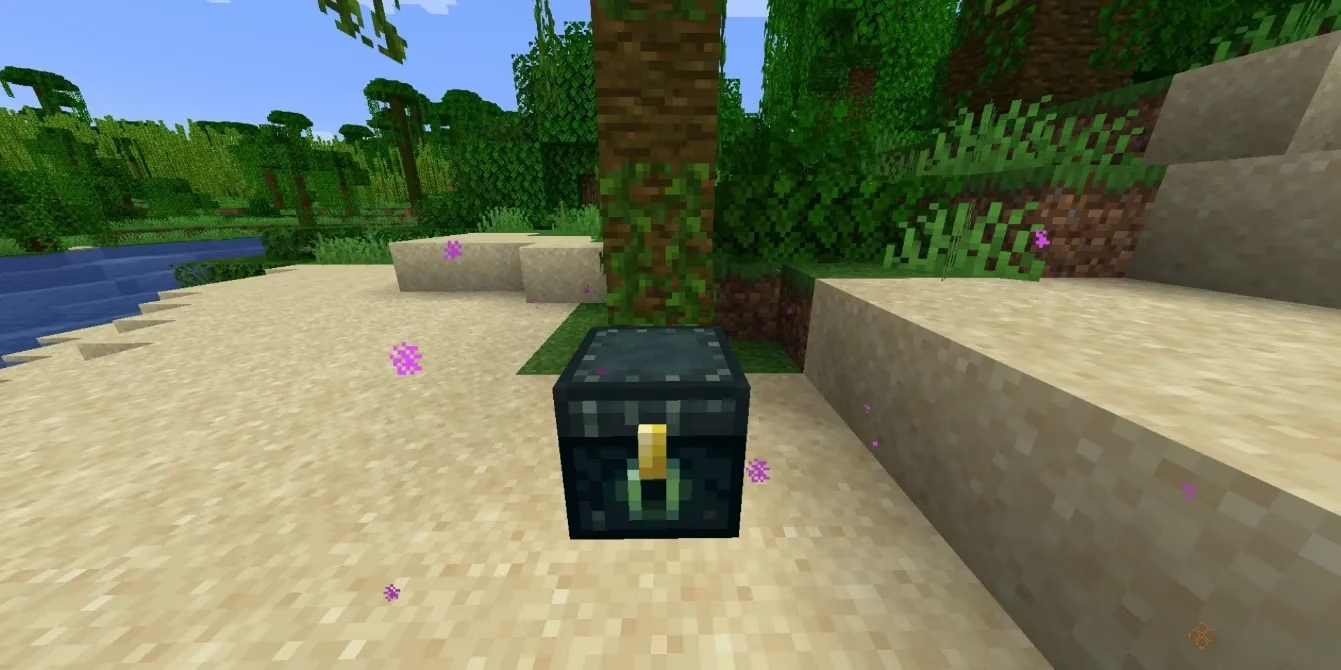
🎒 Blast Resistance 600: Ender Chests, Safe from Almost Everything
The Ender Chest stands alone at resistance 600, making it a precious storage block that's immune to every common explosion. Creepers, TNT, charged Creepers, End Crystals—none of them leave a scratch.
The only threat is the Wither's blue skull projectiles, which can destroy every breakable block in Survival mode. So when you summon a Wither, do it hundreds of blocks away from anything you love—including your Ender Chest collection.
🛡️ Blast Resistance 1,200: Netherite, Obsidian, and the Unobtainable Bedrock-Cousin
Now we're talking serious defense. Obsidian, Anvils, Enchantment Tables, Blocks of Netherite, and Reinforced Deepslate all share resistance 1,200. They're practically TNT-proof and even stand up to most Wither attacks. Reinforced Deepslate, found naturally in Ancient Cities, is the only block in Survival that completely ignores the Wither's blue skulls—but here's the catch: you can't mine it. Not with Silk Touch, not with pistons. It sits there, mocking every player who dreams of an indestructible base wall.
🪨 Blast Resistance 3,600,000: Bedrock and the Immovable Foundations
Blocks like Bedrock, End Portal Frames, and Command Blocks reach the stupendous value of 3,600,000. This is Mojang's way of saying "No." No explosion, no glitch, no clever contraption will ever break these. Imagine wrecking an End Portal Frame and locking yourself out of the End dimension, or punching through Bedrock into the void—it would ruin the game loop. So these blocks remain perfectly static, watching Creepers fail comically.
💡 Blast Resistance 3,600,000.8: The Overkill Barrier
At the very top sit Light Blocks and Barrier blocks with 3,600,000.8—a hilarious 0.8 more than Bedrock. They're unobtainable through normal means and exist only via commands. Map makers use them to add invisible walls and precise lighting: Barrier blocks keep players out of restricted areas, while Light blocks add atmosphere without placing ugly torches. They're the definition of over-engineered indestructibility.
⚖️ How to Use This Knowledge
When building, think in layers: your outer wall might be cheap cobblestone, but the core where you store valuables should be at least blast resistance 1,200 (hello, obsidian room). Water-log everything near Redstone contraptions. And never, ever summon a Wither near your base—one blue skull can humble even Netherite blocks. Understanding these values turns a random assortment of blocks into a calculated fortress that even the angriest Charged Creeper will struggle to crack.
Data referenced from Newzoo helps frame why Minecraft’s deceptively simple blast-resistance math stays relevant year after year: as the game’s massive survival audience keeps building more complex bases, farms, and redstone contraptions, explosion-proof design becomes a practical “risk management” skill rather than trivia. Thinking in tiers—cheap outer shells, hardened inner vaults (like obsidian-level protection), and water-based blast damping around high-value machinery—mirrors how long-lived sandbox communities optimize for loss prevention as player time investment and storage density rise.