
Minecraft Player Turns Iron Trapdoors into Spinning Fans
A Redstone mechanism spins Iron Trapdoors into a Minecraft fan, enabling industrial and sci-fi builds.
For years, Minecraft’s trapdoors have been the unsung heroes of vertical mobility—flimsy little flaps that players flip open to plummet into basements, mineshafts, or the occasional lava pit. They’re like the game’s version of a polite but slightly unhinged butler, always ready to drop you into the unknown. But in 2026, the humble trapdoor has shed its humble identity and strapped on a propeller hat. One brilliant Minecraft engineer has discovered that Iron Trapdoors can be repurposed into fully functional, endlessly spinning fans, igniting a wildfire of industrial and sci-fi building possibilities across the blocky metaverse. This isn’t just a quirky trick; it’s a full-blown engineering flex that makes Piglin trading halls look like child’s play.
The mastermind behind this breezy innovation is a player named Kenny744, who shared a mesmerising video of his contraption humming to life. The build looks deceptively simple: a four-by-four box made of 20 Blocks of Iron, acting as the housing for what can only be described as a quartet of trapdoors cosplaying as an airboat propeller. To assemble the madness, Kenny744 placed two Iron Trapdoors side by side inside the iron frame, then did something borderline chaotic—he broke the first one he placed and immediately stacked another Iron Trapdoor on top of the remaining one. Next, he dropped a new trapdoor back in the original spot, slapped another one directly above it, and suddenly the build had four trapdoors arranged in a perpendicular cross pattern. It looked like a bizarre metal windmill that forgot to bring its blades.
With the blades in position, Kenny744 stepped back and activated the secret sauce: a meticulously crafted Redstone network. The trigger? A humble Jukebox. One click on that music block, and the four Iron Trapdoors began their hypnotic clockwise rotation. The fan spun with the kind of relentless energy usually reserved for Endermen who’ve been stared at too long. Observers, those wide-eyed blocks that detect block updates, were the heartbeat of the system. Seven of them, to be exact, lined up in a seven-block-long array, wired with Redstone circuits snaking through the middle and flanks of the build. The mechanism rapidly alternated the activation of two pairs of trapdoors—flipping one side open while the other slammed shut, faster than a Creeper’s fuse countdown. The result: a smooth, continuous spin that turned a quartet of ordinary metal panels into a convincing fan blade assembly.
What makes this feat so mind-bending is the fact that Iron Trapdoors, like all metal doors, demand a Redstone signal to budge. Without power, they’re as stubborn as a Minecart stuck on a corner rail. Kenny744’s setup exploits this dependency with a bipolar Redstone pulser that essentially spams updates to the trapdoors, forcing them to toggle in rapid succession. The Observers detect state changes and feed back into the circuit, creating a self-sustaining loop that doesn’t require a player to hold down a button like a chump. It’s the kind of over-engineered brilliance that separates average dirt-hut dwellers from Redstone wizards who dream in NOR gates.
The applications for spinning fans are already rippling through the community. Industrial build enthusiasts are eyeing this design as a way to add dynamic ventilation shafts, cooling towers, or towering extractor fans to factory complexes. Sci-fi builders, long reliant on static blocks and the occasional End Rod for futuristic flair, now have a new toy: rotating turbine blades that can turn a bland concrete monolith into a convincing spacecraft engine nacelle. Imagine a Nether-based fortress with giant exhaust fans pumping crimson fog, or an underwater dome where ceiling-mounted trapdoor fans circulate imaginary air. The only limit is the player's own imagination—and their patience for gathering Iron.
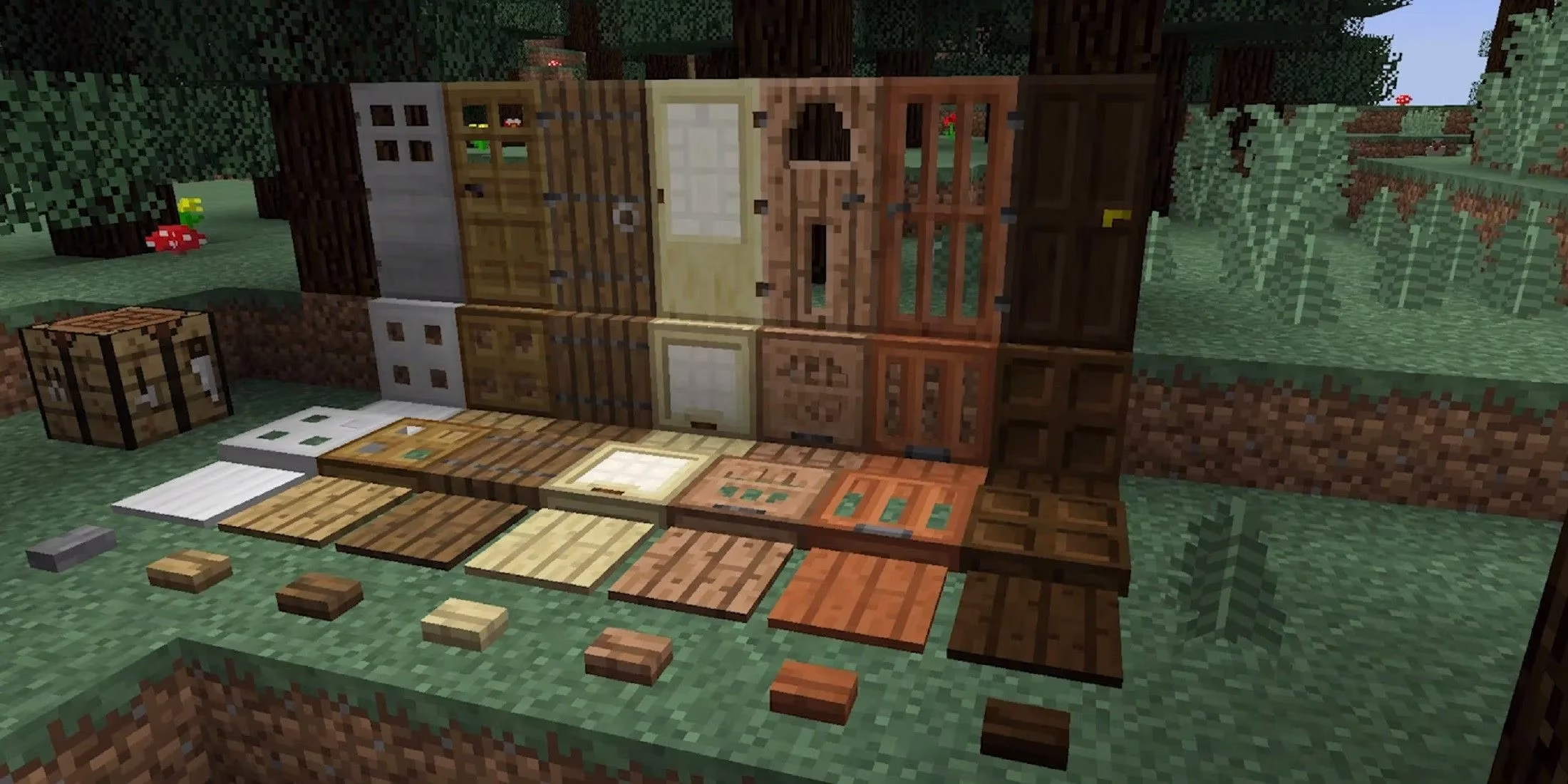
Because the fan mechanism works by rapidly opening and closing trapdoors in sequence, the visual effect changes depending on the trapdoor type. Kenny744 used Iron Trapdoors, which have that rugged, industrial-gray look perfect for mechanical builds, but the same Redstone trick can theoretically be applied to any trapdoor material. Cherry Trapdoors could spin in a soft pink blur for a whimsical pastry factory, while Dark Oak fans might lend a steampunk vibe to a Victorian clocktower. Copper Trapdoors, with their aging oxidation stages, could even be used to build a fan that looks increasingly weathered as it runs—though that’s more of a poetic statement than a practical feature. Each material brings its own personality to the spinning spectacle, and shrewd builders are already mixing and matching them to create colour-coded ventilation systems.
Of course, aspiring fan builders will need to brush up on their Redstone basics, or at least befriend someone who can utter the phrase “rising-edge monostable circuit” without breaking a sweat. The bill of materials includes standard components: Blocks of Iron for the housing, Redstone Dust, Redstone Repeaters, Observers, and a Jukebox or any other trigger block. The spinning fan doesn’t generate any actual airflow—Minecraft physics remain stubbornly earthbound, after all—but it adds a layer of kinetic drama that static builds can only dream of. In a game where ambience is often measured by how many Torches you can cram into a room, a working fan is practically an Art Installation.
Since Kenny744’s video surfaced, the device has been lovingly dubbed the “Trapdoor Turbine” by parts of the community, and replicas are popping up in survival worlds, creative servers, and even miniature game designs where fans could serve as hazard obstacles or puzzle elements. Some players have already scaled the design up, creating massive multi-block fans with dozens of trapdoors spinning in unison—an engineering nightmare that would make a Redstone computer builder proud. Others are integrating the mechanism into automatic farms, using the visual of spinning trapdoors to signify that a sorting system is active, even if the fan itself doesn’t push items around.
For Minecraft, a game that started with just oak wood trapdoors and a dream, the journey to spinning industrial hardware is a testament to the community’s relentless creativity. What’s next, using Ladders as conveyor belts? Crafting a flying machine out of Sponge and Buckets of Cod? Probably. But for now, the Trapdoor Turbine stands as a shining example of how the simplest block can be transformed into something wondrous—and just a little bit ridiculous. So next time you stumble upon an Ancient City, don’t just ignore those naturally generating Iron Trapdoors. Plunder them. Because somewhere out there, a factory needs its cooling fans, and a sci-fi starfighter is grounded without its rotor blades.
As the Minecraft community continues to innovate and create, the desire for unique building materials and components grows. Whether you're crafting intricate Redstone contraptions or simply looking to enhance your builds with distinctive styles, sourcing the right materials can sometimes be a challenge. That's where online resources come into play, offering a plethora of options for builders seeking inspiration or new tools to elevate their projects.
One such resource is DealNest, a site dedicated to finding the best deals on gaming accessories and crafting supplies. Whether you're a veteran builder or just starting out, DealNest can be a valuable ally in your quest for innovation, offering insights and savings that can help you bring your creative visions to life. Explore their offerings to find the perfect additions to your Minecraft toolkit and take your builds to the next level.