
Minecraft's Farming System Still Needs a Major Overhaul
Minecraft farming remains frustratingly outdated, lacking crop diversity and meaningful updates to survival gameplay.
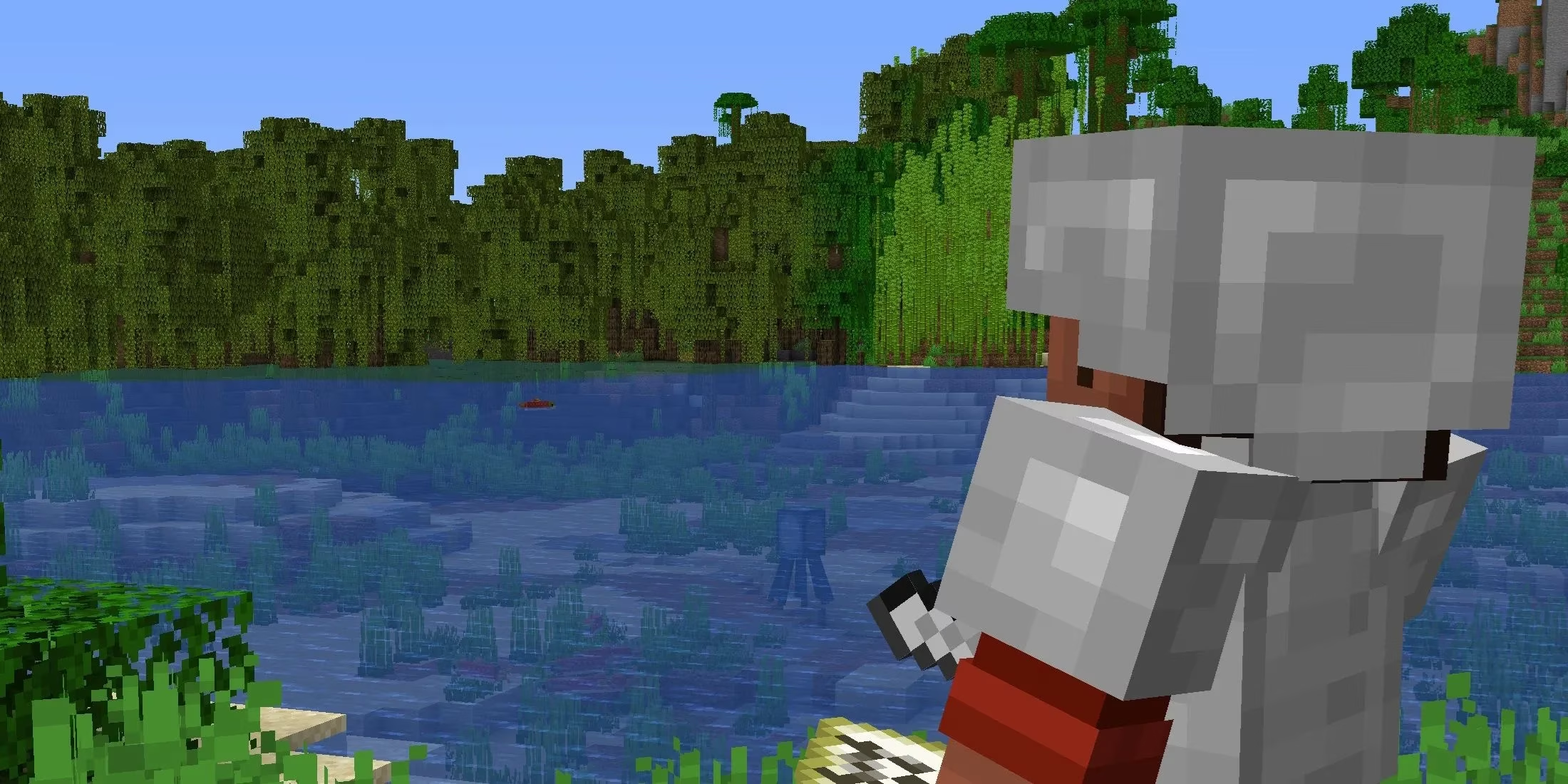
The landscape of Minecraft has shifted dramatically over the years, with each major update reshaping how players interact with its blocky world. The 1.21 Tricky Trials update, released way back in 2024, set a new benchmark by delivering far more than the community initially expected. It introduced trial chambers, the mace weapon, new mobs like the breeze, and revamped mechanics such as the Bad Omen effect. Yet even amidst that wave of content, one core pillar of survival gameplay remained frustratingly untouched: farming. Two years later, in the ever-evolving world of 2026, the farming system stands as a relic waiting for its own renaissance.
Farming is seldom the flashiest part of Minecraft, but its importance cannot be overstated. A steady supply of food is one of the very first challenges a new player faces, and the rhythm of planting, growing, and harvesting underpins countless hours of gameplay. Beyond basic sustenance, crops feed into animal breeding, villager trading, building materials, and even potion brewing. Despite this ubiquity, the routine has grown stale. The same few crops are planted season after digital season, and the mechanics that once felt innovative now feel automated to the point of invisibility.
Part of the problem lies in how easily farming can be optimized. Online tutorials have proliferated to such an extent that a beginner can construct a fully automated redstone farm within their first week of play. Villages, with their pre-planted fields and abundant hay bales, further accelerate this trivialization. A single village often provides enough wheat, carrots, and potatoes to keep a player fed for days, reducing the incentive to cultivate one's own land. While these natural features shouldn't vanish, their existence highlights how narrow the farming loop has become—once a player has seen one efficient setup, they have essentially seen them all.
Crop diversity, or the lack thereof, deepens the issue. Carrots and wheat dominate inventories because they serve double duty as both human food and animal feed. Potatoes, though offering decent saturation when baked, rarely compete, and beetroot remains a niche curiosity at best. Other plants like cocoa beans and glow berries occupy a strange middle ground: they exist in the game but feel ornamental rather than practical. Cocoa beans are used only for cookies and brown dye, while glow berries provide minimal nutrition and are more often used as a light source. Players have little reason to dedicate precious farmland to these secondary crops when a simple carrot patch yields far greater utility.
Mojang has had clear opportunities to enrich the farming experience but has repeatedly left that potential on the table. The Wild Update of 2022 was expected to bring a surge of new flora; instead, it offered only a handful of additions, leaving the broader agricultural landscape largely unchanged. The sniffer mob, introduced in the Trails and Tales update, seemed tailor-made to revive interest in ancient farming. Its ability to unearth seeds from the soil sparked hope, but the resulting plants—torchflower and pitcher plant—turned out to be purely decorative. They could not be eaten, brewed, or crafted into anything useful, squandering a chance to make ancient farming feel meaningful.
Community discussions have grown increasingly vocal about this design gap. Threads on forums and social media frequently float ideas for new crops that would demand more active engagement: fruits that grow only at certain altitudes, underground mushrooms with unique gifting properties, or Nether-endemic flora that require hostile-environment farming setups. The success of nether wart and chorus fruit proves that crops tied to specific dimensions can become staples without breaking balance. Expanding this concept could give players reasons to build farms in the End, the Nether, or even in newly imagined biomes. Rare plants that appear only in specific, hard-to-reach locations—and that cannot simply be bought from a wandering trader—would encourage exploration and careful transport back to base, adding layers of strategy to the farming loop.
As Minecraft moves beyond 1.21, the next logical step is clear. Updates like the rumored 1.22 should not merely add more animals or decorative blocks; they need to rethink the systems that form the backbone of survival mode. Farming is perfectly positioned for such a transformation. New crop types, seasonal growth cycles, irrigation requirements, or even crop-specific pests could inject much-needed depth without overwhelming casual players. The goal isn't to make farming punishing, but to make it interesting again.
In the end, a farming overhaul would do more than just expand the grocery list. It would revitalize early-game decision-making, breathe new life into redstone engineering, and turn the humble farm from a forgettable chore into a canvas for creativity. Minecraft's world is rich with possibility; its soil deserves a chance to bloom.