
Mississippi Reborn in Blocks: A Minecraft Artist's 1:20 Scale Masterpiece
Minecraft and Mississippi meet as a player crafts an impressively detailed 1:20 scale map, blending digital creativity with cartography.
In 2026, the boundary between digital creativity and cartography continues to blur in remarkable ways. One Minecraft player has pushed this frontier by sculpting an astonishingly faithful replica of the state of Mississippi, complete with its winding rivers, lush forests, and sprawling urban outlines. The massive project, shared by Reddit user AtmosphericBeats, captures the Magnolia State at a 1:20 scale within the Java Edition of the game, transforming real-world geography into a playable blocky landscape. It’s not just a rough outline; the map features distinct borders for neighboring states, scattered barrier islands along the Gulf Coast, and a rich tapestry of native biomes—plains, deserts, beaches, rivers, and even taiga—carefully chosen to mimic the ecological diversity of the region. What drives a builder to painstakingly recreate an entire state? For AtmosphericBeats, the answer lies in a fusion of programming prowess and a deep appreciation for local geography.
The project astonished many when it surfaced on Mississippi’s official subreddit. Screenshots revealed a staggering level of detail: the sinuous curves of the Mississippi River, the patchwork fields of the Delta, and the gentle rise of the Piney Woods. Residents of the state chimed in with personal anecdotes, pointing out their hometowns and marveling at how accurately lay-of-the-land features had been translated into cubes. One commenter noted that even the subtle bend of a creek near their childhood home seemed to be in place—a testament to the creator’s meticulous approach. Such immersion invites a compelling question: is it possible to feel a sense of nostalgia for a digital landscape that mirrors your own backyard? Judging by the flood of grateful reactions, the answer is a resounding yes.
But how does one even begin to craft such a vast and precise world? AtmosphericBeats didn’t build it block by block from memory. Instead, they developed custom external software that pulls geospatial data from open-source map repositories and translates it into Minecraft’s terrain generation logic. Elevation contours, water body boundaries, and land cover types were all converted into in-game features using sophisticated algorithms. The result is a procedurally assisted yet hand-tuned map where highways become gravel paths, urban footprints transform into village-like clusters, and real-world forests bloom as pixelated oaks and birches. The 1:20 scale means that every Minecraft block represents approximately 20 meters of actual terrain, offering a perfect balance between explorable size and geographic fidelity. This technical achievement echoes a broader trend within the Minecraft community: using the game not just as a canvas for fantasy but as a tool for digital preservation and education.
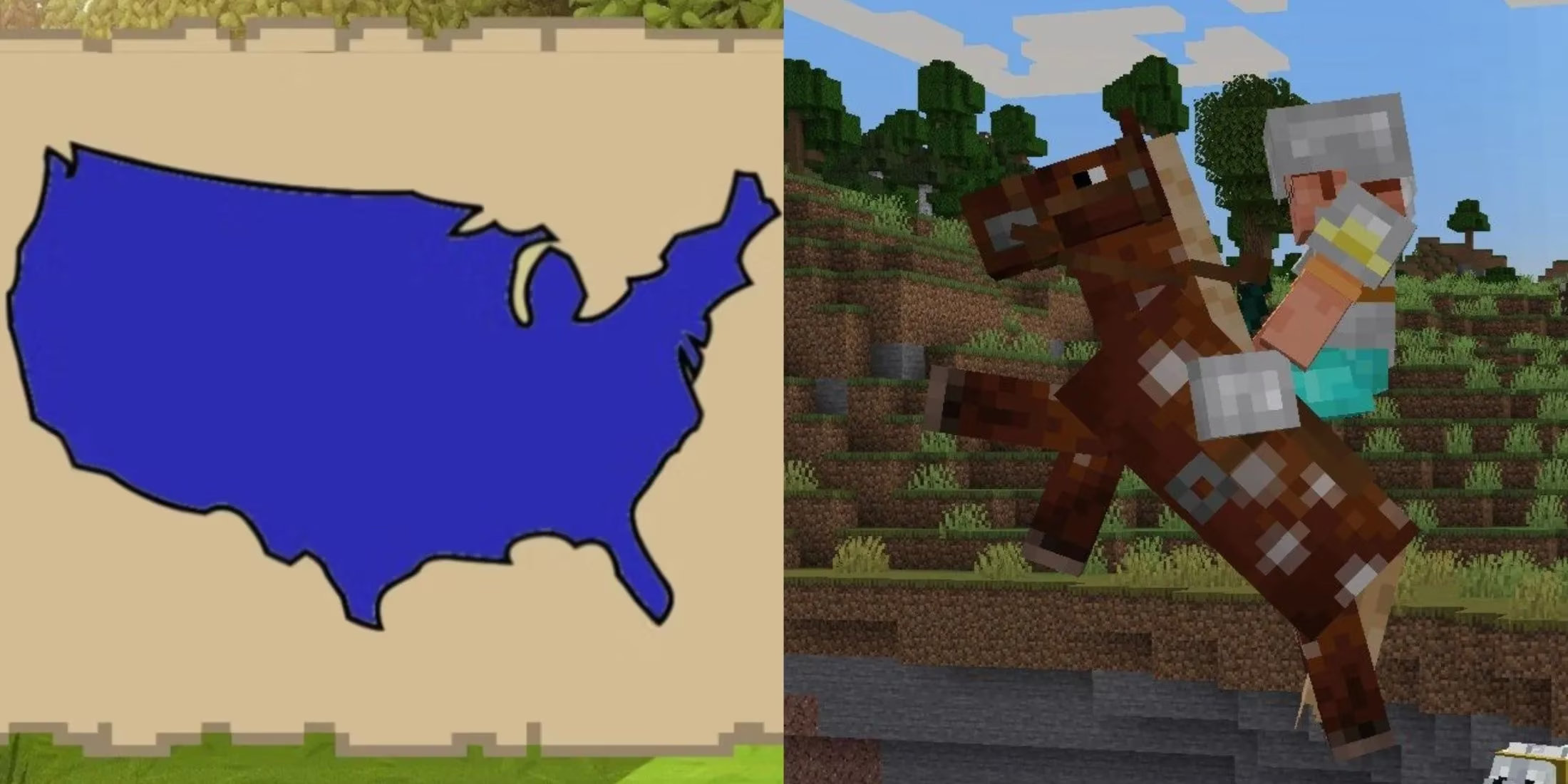
The reception quickly spread beyond Reddit. On Planet Minecraft, where the creator hosts their entire portfolio, the Mississippi map joined a growing catalog of real-world recreations. Enthusiasts can now download and explore lifelike renditions of Hawaii’s volcanic islands, the sun-soaked peninsula of Florida, and even a continent-spanning version of the entire United States—all built by the same determined individual. Each map presents its own unique biome puzzle, requiring a clever mix of Minecraft’s native environments to simulate everything from swamps to snowy peaks. The Mississippi project, however, holds a special charm because of the intimate way it reconnects locals with their environment. After all, how often can a gamer wander from the Delta to the Gulf without leaving their chair?
Minecraft has long been a platform for ambitious geographic homages. Years ago, another player famously attempted to reconstruct the entire Earth, complete with its continents and oceans. More recently, The Nature Conservancy released an official Minecraft map to raise awareness about ecosystems and conservation. What sets AtmosphericBeats’ work apart is the combination of grassroots passion and technical innovation. By sharing their map freely online, they’ve invited Mississippians to host virtual homecomings—perhaps to build their own houses exactly where they stand in reality or to simply drift down a blocky version of the Pearl River in a boat. The collaborative potential is immense: community servers could spring up, turning the map into a living, breathing digital twin where residents shape their own blocky history.
Looking at the project’s details, one can spot iconic landmarks woven into the terrain. The busy harbor of Gulfport is hinted at by a dense cluster of blocks near the shore; the expansive Ross Barnett Reservoir appears as a serene sheet of blue nestled among hills. Even the barrier islands—Petit Bois, Horn, Ship—are distinguishable, dotting the southern edge of the map like emerald stepping stones. And yet, the landscape is not a perfect one-to-one copy; Minecraft’s inherent charm softens the harsh geometries of urbanization, replacing asphalt with grassy blocks and concrete with cobblestone. This reinterpretation raises a philosophical question: does a simplified, blocky world capture the essence of a place more powerfully than a photorealistic map? Many would argue it does, because it invites us to engage with geography on a human scale, to walk every riverbank and crest every hill ourselves.
As of 2026, AtmosphericBeats shows no signs of slowing down. Their Planet Minecraft profile teases future projects, leaving fans to speculate wildly in forum threads. Could a detailed map of Alaska be next, with its towering mountains and sprawling tundra? Or perhaps a microscale version of New York City, where every skyscraper stands as a gigantic monument of blocks? Whatever comes next, the Mississippi map remains a shining example of what happens when coding skills meet a love for local topography. It reminds us that Minecraft is more than a game—it’s a mirror that can reflect the real world in all its pixelated glory.
For those yet to dive in, the experience promises hours of adventure. Want to trace the Natchez Trace Parkway on horseback? Go ahead. Dream of building a replica of the Biloxi Lighthouse? The shoreline awaits your creativity. The map is both a finished masterpiece and a foundation for infinite personalization. By turning an entire state into a playground, AtmosphericBeats has given the community more than just a download; they’ve gifted a new way to see and appreciate the place they call home.