
My First Steps into Minecraft VR on Quest 3
Experience unparalleled Minecraft VR on Meta Quest 3 with QuestCraft's 5.0 update, delivering smooth 120 FPS and mod support.
I still remember the first time I truly felt Minecraft. Not just watched it on a flat screen, but actually stood inside that blocky world, looking up at a sky of pixelated clouds, the grass blocks beneath my feet. It was 2026, and I had finally decided to dive into the QuestCraft experience on my Meta Quest 3. The journey there, however, started years ago with a simple question: why wasn't there an official, standalone Minecraft VR port for the Quest?
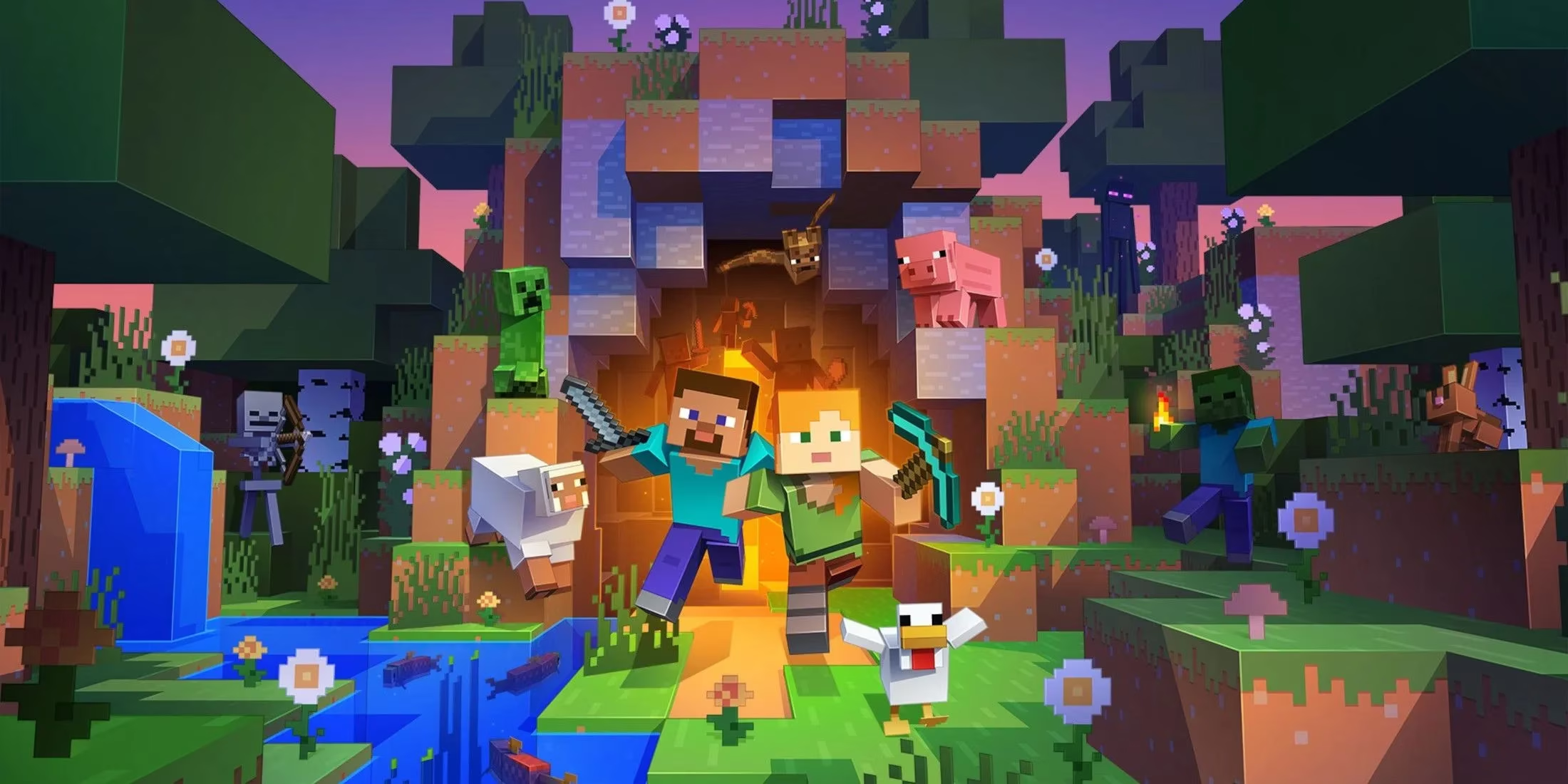
For years, the answer was a confusing mix of PC-tethered solutions and experimental mods. But the community never gave up. QuestCraft, a fan-made port, had been around, yet it was limited to the Quest 2. I had been holding out, hoping the developers would unlock the full potential of the newer hardware. Then, the 5.0 update landed. Performance soared, mod support deepened, and suddenly, my Quest 3 became the ultimate Minecraft machine. The promise of exploring infinite worlds without wires was finally real.
The first thing that hit me was the smoothness. Before, I had heard stories of a 45 FPS cap, but on the Quest 3, the hand-tracking and head movement ran at a buttery 120 FPS. It was transformative. I loaded up a world I had been building on my PC for months, a sprawling medieval city filled with towering castles and intricate redstone contraptions. In the VR headset, it was no longer a model I observed; I was a giant walking through my own creation. I ducked under low archways, reached out to open iron doors, and even leaned over the edge of my tallest tower, feeling a genuine rush of vertigo. Could any pancake screen replicate that sensation?
QuestCraft's 5.0 update didn't just boost performance. It opened the door to a universe of modifications. I had always been a mod enthusiast, adding shaders and realistic textures to my Java Edition. Now, the built-in mod manager let me install those same visual overhauls directly onto the headset. I enabled a ray-tracing-like shader pack, and suddenly, the sun cast warm, cascading shadows through the oak leaves, water reflected the sky with stunning clarity, and the entire world felt alive. The blocky esthetic remained, but it was wrapped in an atmosphere so immersive I forgot I was standing in my living room.
Installing the whole thing was a small adventure in itself. Since QuestCraft 5.0 isn't on the official Meta Quest Store, I had to sideload it through the SideQuest platform. The process was surprisingly straightforward—plug in the headset, grant a few permissions, and transfer the APK. Of course, I needed a legitimate copy of Minecraft: Java Edition, a small price for the countless hours of joy that followed. The developers even brought the port to Pico VR headsets a couple of years ago, spreading this homemade magic to an even wider audience. The community's dedication is, frankly, astonishing.
What drives someone to spend years crafting an unofficial port? The same force that keeps millions of us returning to a game about placing and breaking blocks: pure, unadulterated freedom. In my VR world, I wasn't just a player; I was the architect of my own reality. One evening, I decided to dig a mine the old-fashioned way. I equipped my pickaxe, swung my real arm, and heard the satisfying thunk of stone breaking. I methodically chipped away, creating a staircase downward, placing torches as I went. When I stumbled upon a cave system echoing with zombie groans, my pulse genuinely quickened. I crept forward, shield raised, peeking around corners. That primal fear of the dark, the joy of discovering diamonds—they are amplified tenfold when you're inside the cave.
And what about the social side? I joined a friend on a realm, both of us wearing our headsets. We built a roller coaster that twisted through a mountain, and riding it together, throwing our hands in the air at every drop, felt like visiting a virtual theme park we ourselves had designed. Mods that added new dimensions or creatures became expeditions we undertook side by side. The performance improvements meant our massive world, filled with complex machines and hundreds of animals, never stuttered. The 120 FPS cap was more than a number; it was the difference between feeling like a ghost with a camera and truly inhabiting my avatar.
Now, as I sit back in my chair, gently removing the headset, the real world seems muted. The flat, glowing screen of my monitor looks like a postcard of the vibrant realm I just left. Minecraft, at its core, has never been about realistic graphics. Yet, thanks to tech like QuestCraft and the tireless modders who push boundaries, those blocky visuals become a canvas for experiences that rival any AAA title. So I ask you: have you really played Minecraft if you haven't stood inside it? The tools are here, the community is thriving, and the frontier is limitless. All you need is a headset and the courage to step through the portal.