
The Eternal Wonder of Minecraft's Generated World: Easter Island Statues and Beyond
Minecraft's procedural generation and Easter Island moai mountain showcase the game's wondrous, infinite potential for breathtaking discoveries. This digital marvel inspires awe and exemplifies the beautifully bizarre landscapes awaiting every curious explorer.
In the boundless, pixelated universe of Minecraft, the land itself breathes with a life of its own, whispering secrets of improbable formations to those who wander with a curious heart. The year is 2026, and the digital soil of Mojang's creation continues to sprout miracles, where mountains can wear the solemn faces of ancient civilizations. A testament to this is the recent, wondrous discovery by a traveler known as XenoWoof, who, while charting the overworld in version 1.21.4, encountered a mountain that bore an uncanny, silent gaze. This was no ordinary peak; it was a monument sculpted not by hand, but by the game's own procedural heartbeat, a geological echo of the moai statues of Easter Island.
The resemblance was hauntingly poetic. Indentations near the summit served as deep, watchful eyes, while a solitary, protruding rock below formed a proud, stoic nose. This digital titan, standing guard over its biome, captured the collective imagination of the Minecraft community, garnering immense admiration and over 9.1K expressions of awe. It stands as a perfect symbol of the game's core allure: a world so vast and randomly generated that it forever promises the new, the unexpected, the beautifully bizarre. XenoWoof, in a spirit of shared exploration, provided the seed and coordinates, inviting others to witness this natural marvel for themselves—a testament to the collaborative wonder that defines the player base.
This is but one verse in an endless epic of discovery. Minecraft's terrain generation is a masterful dance of chaos and algorithm, where the familiar—villages, outposts, forests—is woven into a tapestry of infinite variation. The result is a landscape that feels both known and utterly alien, a place where every canyon and hilltop holds potential for surprise.
✨ A Chronicle of Digital Serendipity:
| Discovery | Description | Why It's Magical |
|---|---|---|
| The Gru Mountain | A terrain formation bearing a striking, comical resemblance to the animated character Gru. | Shows the playful, almost conscious whimsy of the generation code. |
| Sky-High Villages | Entire villages generated floating precariously or embedded in sheer cliffsides. | Turns routine exploration into a breathtaking narrative of improbable habitation. |
| Floating Island Chains | Clusters of land defying gravity, creating ethereal archipelagos in the sky. | Evokes a sense of pure fantasy and wonder, challenging the very laws of the blocky world. |
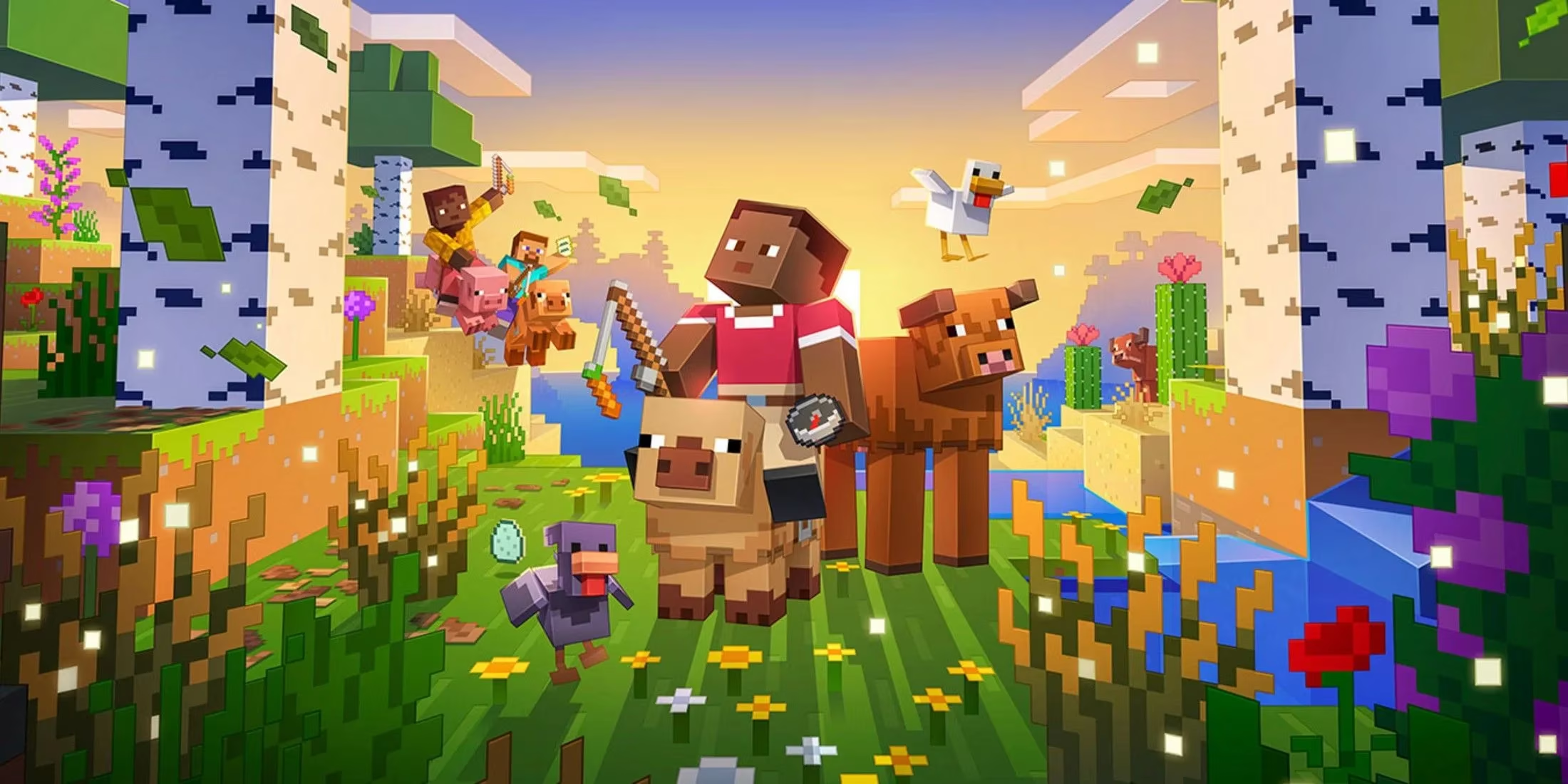
These are not glitches, but features of a living world. They are the happy accidents of a system designed to avoid repetition, ensuring that even after fifteen years, no two journeys are ever the same. The game's enduring relevance is fueled by this very principle, coupled with Mojang's steadfast commitment to growth. The Spring to Life update, released in March 2025, infused the world with new mob variants and ambient details, further enriching the biomes for explorers. It is a cycle of perpetual renewal: new content begets new landscapes, which in turn beget new, wondrous discoveries to be shared like digital folklore.
As we look to the horizon in 2026, the promise of Minecraft remains undimmed. The community's galleries are virtual museums of these chance encounters, each screenshot a poem about perspective and possibility. They remind us that adventure is not just about seeking predefined treasures, but about developing the sight to see the extraordinary in the ordinary stone. The mountain that looks like a moai is more than a quirky formation; it is a monument to the game's soul—a proof that within its seemingly simple systems lies a boundless capacity for awe, waiting for the next player to turn a corner and have their breath stolen by the world's silent, generated poetry. The next great discovery is always just beyond the next chunk load, a mystery in the code, a story yet to be told by the land itself. 🌄