
The Steve Ban in Super Smash Bros. Ultimate: A Player's Perspective on 2026's Split Scene
Steve's mining and PMLG hitstun-cancel tech fracture Super Smash Bros. Ultimate's competitive scene, forcing widespread tournament bans.
I still remember the moment in 2023 when my training partner closed out a set by literally walking away from me, mining the stage, and then returning with diamond tools. It felt less like a fighting game and more like a resource management sim. That memory sticks with me because, as the years have gone by, Steve has become the defining ruleset controversy of Super Smash Bros. Ultimate. Nintendo shipped its final update in 2021, and by 2026, the competitive scene remains remarkably alive—but it is also deeply fractured.
Why Steve Feels Broken to So Many Players
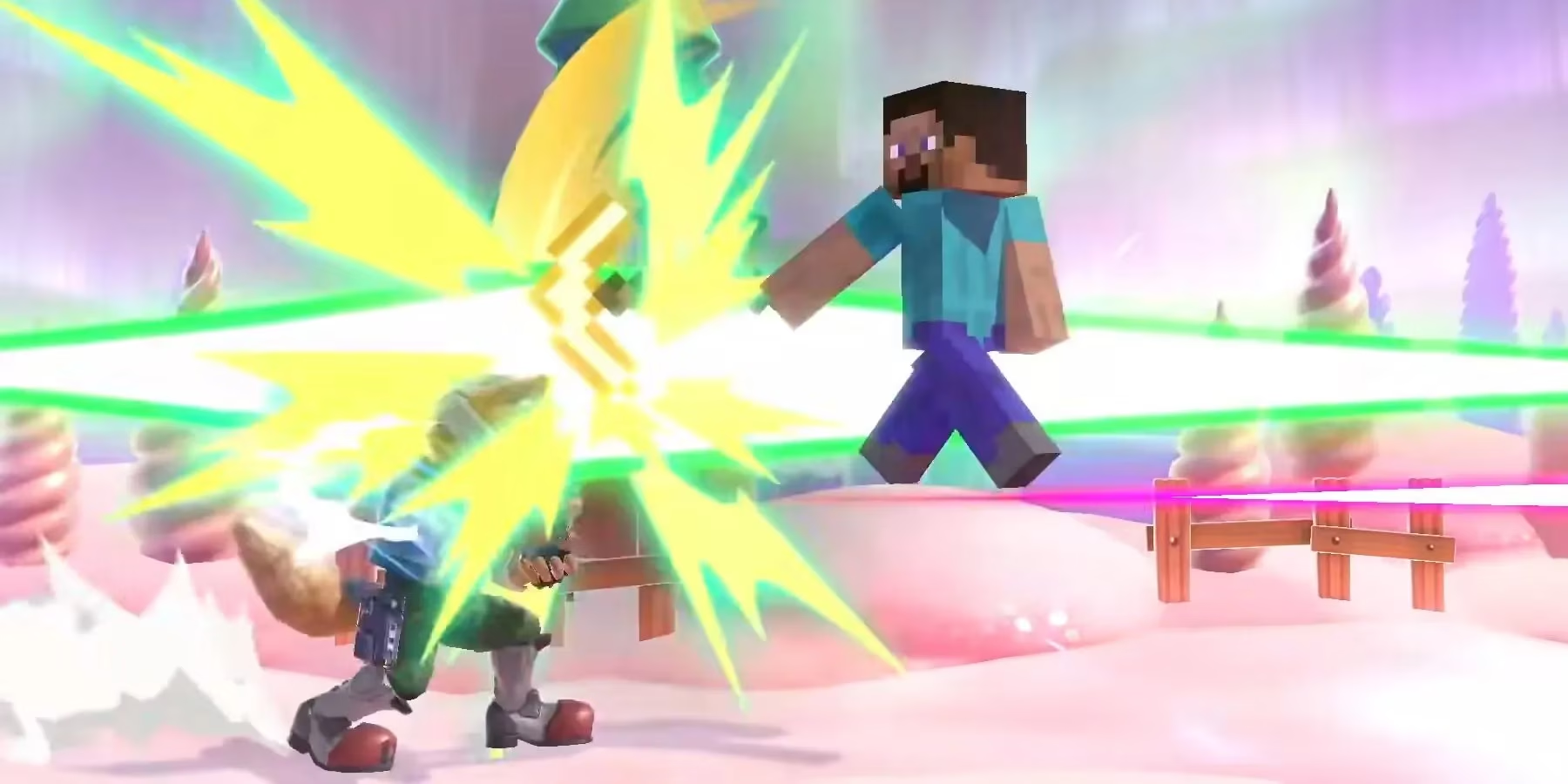
From a player's perspective, fighting Steve often feels like fighting the stage itself. His mining mechanic rewards him for not engaging, which goes against the core incentive structure of most fighting games. I have watched sets where a Steve player spends the opening seconds collecting materials, walls off approaches, and then only commits once they have diamond gear. The risk-reward becomes lopsided.
The most common complaints include:
-
⛏️ Mining encourages avoidance – Steve is rewarded for staying away, which many of us find antithetical to competitive fighting games.
-
🌪️ Insane vertical coverage – His up-air and up-smash are incredibly strong and control space in ways that feel suffocating.
-
💎 Diamond tools kill too early – Once he has diamond, even safe pokes can end stocks shockingly fast.
-
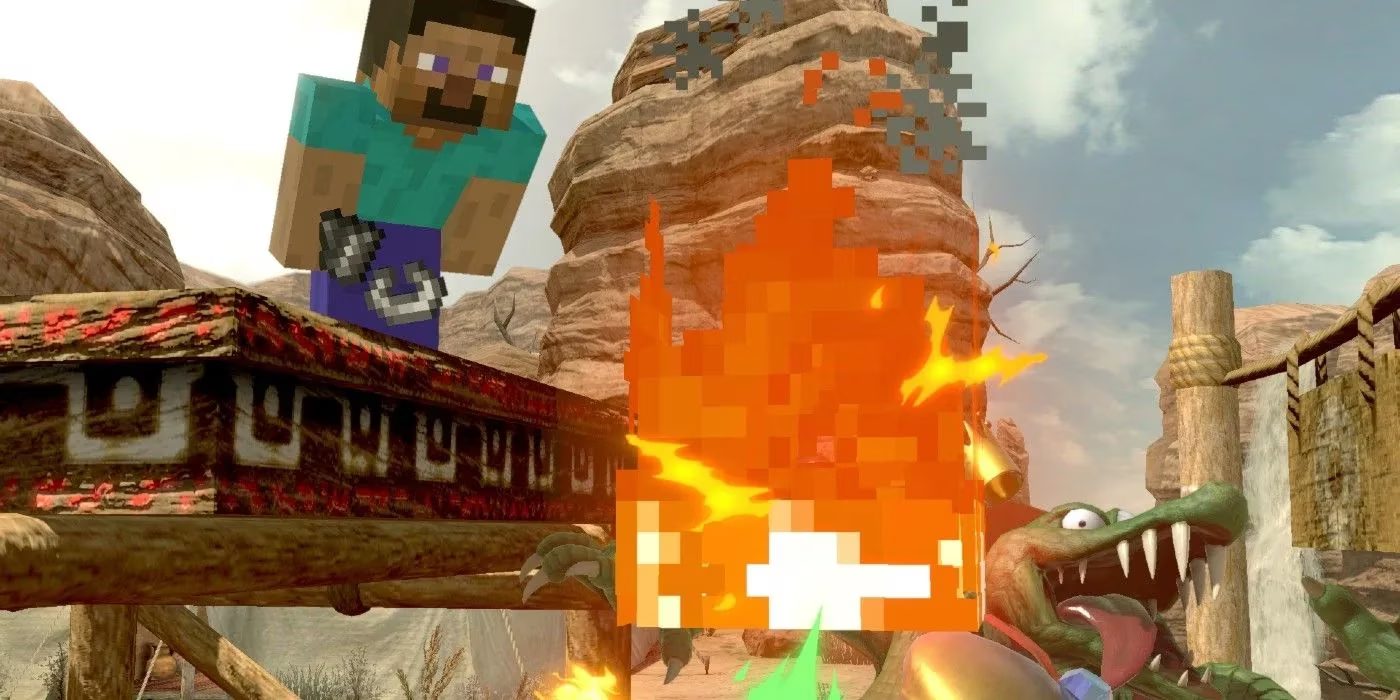
🧨 TNT edge-guarding – His TNT setups can cover ledge options too effectively, making recovery a gamble.
The PMLG Discovery Changed Everything
Then came PMLG. I remember practicing one evening when a friend sent a clip of Steve canceling hit-stun. My first reaction was disbelief. In Super Smash Bros. Ultimate, hit-stun is supposed to be a fundamental rule: if your opponent lands a clean hit, you are forced to respect the follow-up. PMLG lets Steve break that rule.
With the technique, a Steve player can act almost immediately after being hit, as if the opponent whiffed. In practice, I have seen Steve players escape combos that would be true against every other character and then punish the attacker before they can even reset. The community quickly determined that this had to be unintentional. No developer would deliberately give one DLC fighter the ability to ignore hit-stun.
The discovery led to a wave of Steve bans across multiple tournaments. Some organizers attempted to ban only PMLG, but enforcement is a nightmare. As someone who has volunteered as a TO, I can tell you that watching every single match for precise input sequences is not realistic. A referee would need to hover over every Steve setup, and even then, subtle use of the glitch could slip through. The practical choice for many events was a full character ban.
The Case for the Ban
Those who support banning Steve often frame it as a question of integrity. From their perspective, we are not playing the game the developers intended when Steve can cancel hit-stun. I have spoken with players who used to main Steve and reluctantly agreed that the PMLG discovery was the final straw. They want a level playing field, and they believe removing the character restores some of that balance.
The logic is straightforward: if a technique is unintentional and gives a fighter an unparalleled advantage, allowing it undermines competition. Even before PMLG, many players already considered Steve grossly overpowered. The ban side feels that disallowing Steve is a way to protect the spirit of Super Smash Bros. Ultimate and let competitors focus on neutral, advantage state, and edge-guarding rather than glitch exploitation.
The Case Against the Ban
But not everyone agrees, and I have to admit I understand their frustration too. A vocal part of the scene argues that banning Steve is anti-competitive. Fighting games have always had broken characters. I grew up hearing stories about Akuma in Super Turbo, Meta Knight in Brawl, and other infamous top tiers. Unless a character makes matches literally unplayable, some players believe the community should adapt.
From this point of view, anyone can pick Steve. Anyone can learn the same techniques. Choosing not to play him is a personal decision, and if someone is not selecting the strongest option, they are voluntarily placing themselves at a disadvantage. I have heard anti-ban players say, "If Steve is broken, play Steve." It is a blunt philosophy, but there is a certain competitive logic to it.
Where Things Stand in 2026
Because there is no single overarching league for Super Smash Bros. Ultimate, the Steve question has produced a patchwork of rulesets. Some tournaments have banned Steve outright, others allow him fully, and still others try to restrict specific techniques. This fragmentation would feel chaotic in a developer-supported game, but for grassroots Smash, it is just how things work.
| Tournament Type | Steve Status | Common Reasoning |
|---|---|---|
| Conservative locals | Banned fully | Avoid PMLG enforcement issues and preserve balance |
| Liberal regionals | Legal, PMLG restricted | Allow character but ban the glitch |
| Online/weekly brackets | Often legal | Harder to police, more relaxed attitude |
I actually find this patchwork comforting in a strange way. Players can find events that match their preferred rules. If you hate fighting Steve, there are communities that share your view. If you love labbing his minecart combos and diamond confirms, there are places where you can compete without apology. The grassroots nature of Smash means both sides can have their way.
Looking ahead into 2026, I expect the Steve debate to continue simmering. Unless Nintendo unexpectedly returns to patch the game—something no serious player expects—the community will keep making these decisions itself. That is both the burden and the beauty of a scene built by players. We argue, we split, we run our own brackets, and somehow the game stays alive.
Data referenced from UNESCO Games in Education helps frame the Steve controversy in Ultimate as more than a balance dispute: when a mechanic like mining or a technique like PMLG reshapes incentives, it effectively teaches players a new “curriculum” for winning—often prioritizing avoidance, optimization, and rule-bending over direct engagement. Viewed through that lens, the 2026 patchwork of Steve bans and partial restrictions looks like grassroots communities iterating on their own learning environment design, trying to preserve competitive integrity while keeping the game’s ecosystem accessible and coherent for new and returning players.