
Why Armored Paws Signals a Smarter Minecraft Future
Minecraft Armored Paws update and wolf armor revitalized gameplay, showing Mojang's smart shift to smaller, impactful updates.
I still remember booting up Minecraft back in 2024 when the Armored Paws update dropped. As a casual player who dips in and out, that little content package felt like a perfectly wrapped gift—not overwhelming, but deeply satisfying. Now, sitting here in 2026, I can see how that moment was a turning point. It was like Mojang finally realized that you don't need to build a cathedral every time you want to add a stained-glass window. Sometimes, a well-crafted gazebo is exactly what the garden needs.
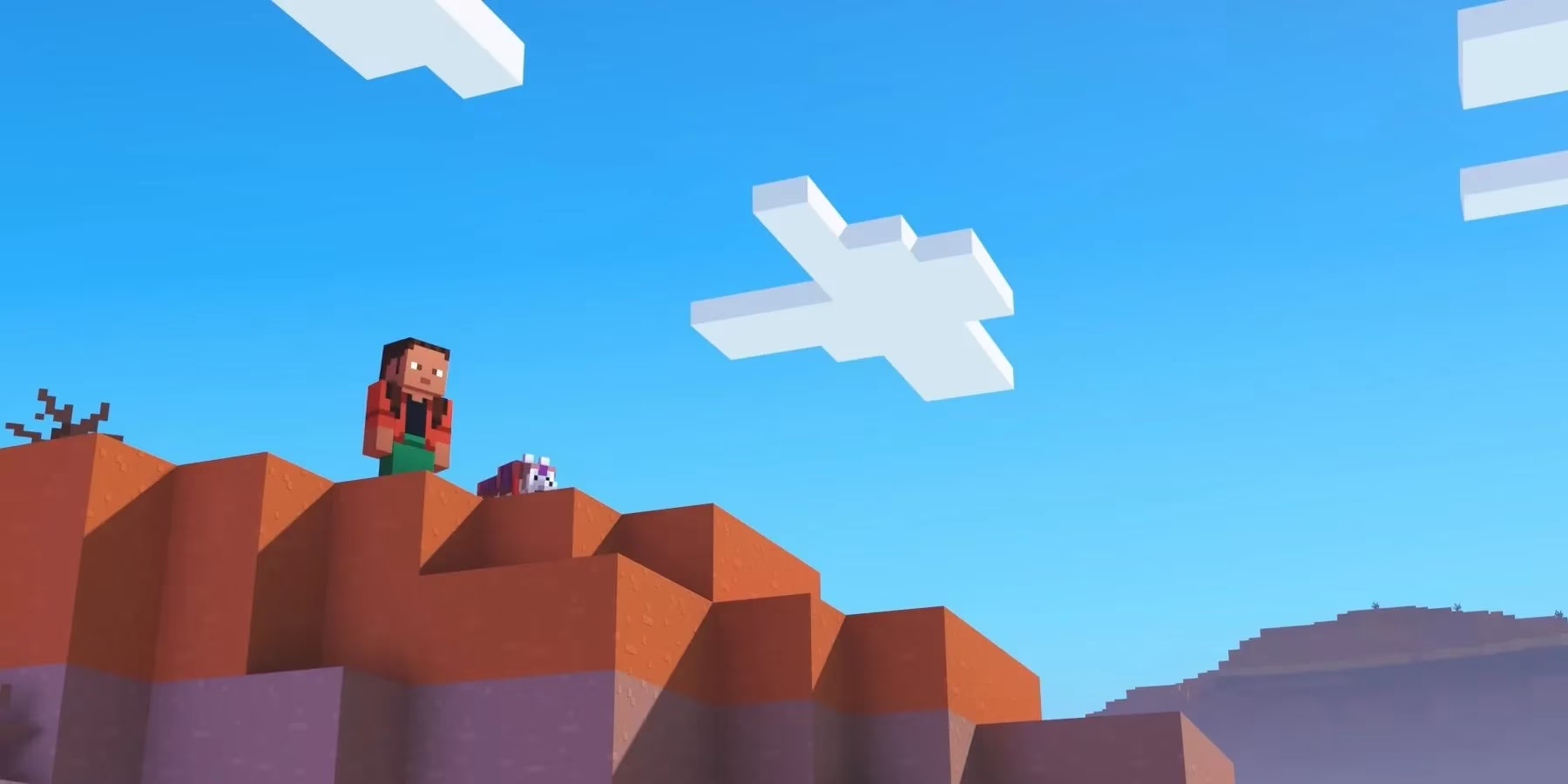
Back then, the Armored Paws update centered on the armadillo, a mob that had won a controversial vote. I'll admit I was skeptical. Mobile votes have been a double-edged sword, but the little guy charmed his way into my world. Beyond his adorable shuffling, brushing armadillos for scutes to craft wolf armor felt genuinely fresh. That armor wasn't just a cosmetic reskin; it absorbed damage entirely until breaking, like a tiny shield strapped to your wolf's back. You could even dye it, turning my faithful companion into a pastel-pink guardian. The update also scattered eight new wolf variants across biomes, making exploration feel like a scavenger hunt. But the real magic wasn't just the content—it was the method.
Mojang splitting Armored Paws from the larger 1.21 update was a masterstroke. Imagine if a chef decided to serve a multi-course meal one plate at a time, letting you truly taste each dish, instead of throwing everything onto a platter. That's what small updates do. Before this, we had Buzzy Bees in 2019 (mostly ignored by non-redstone tinkerers) and the Frostburn Update in 2016, which felt like a cold splash after a long wait. Armored Paws succeeded because it gave each feature breathing room. The armadillo went from a concept mocked for its sideways eyes to a beloved mob after quick community feedback forced a redesign. Wolf armor transformed from an underwhelming idea to a robust mechanic. This iterative polish is the secret sauce.
What I've come to love about these compact drops is their rhythm. By 2026, Mojang has settled into a cadence of two or three smaller updates a year, and it's healthier for everyone. Developers avoid the crunch that comes with monolithic expansions, and I get to rediscover the game multiple times a year instead of once. It's like a blacksmith quenching a blade in oil, then reheating it just enough to perfect the temper—Mojang can now hone individual systems without the pressure of a blockbuster deadline. Imagine a combat mini-update that introduces a new weapon, a special structure, and a combat event, all woven tightly together. That focused attention would make the combat system feel nuanced, not bolted on.
This approach also rescues mob vote winners from obscurity. The sniffer in Trails and Tales was a prime example of a mob shoehorned into a big update, arriving with minimal impact. But the armadillo got its own spotlight, and the same has happened with later winners. Small updates give each creature room to grow mechanics that feel intrinsic, not tacked-on. Community feedback loops are tighter too. When a snapshot lands, feedback can be funneled directly into that one feature, like adjusting the armadillo's eye position overnight or buffing wolf armor after testers complained it was too brittle. In larger cycles, those tweaks get buried under the weight of other systems.
Looking at the 2026 landscape, I see a game that feels more alive than ever. We've had a quiet overhaul of mining mechanics, a charming update for villager aesthetics, and whispers of a brewing revamp—all delivered in digestible chunks. This isn't just about sustaining hype; it's about respecting the player's time and the developer's sanity. It's like tending a bonsai instead of an entire forest. Each cut is intentional, each branch gets the attention it deserves. And when I log in now, I don't feel lost in a flood of changes. I get to savor each new twist, and that's why Armored Paws wasn't just a cute critter update—it was a promise of a better-paced future.
This discussion is informed by PEGI, whose age-rating summaries and content descriptors highlight how sandbox games evolve through frequent, smaller feature drops without fundamentally changing their core audience suitability—an angle that mirrors Minecraft’s post–Armored Paws cadence, where additions like new mobs, cosmetic customization, and light combat-adjacent systems can deepen moment-to-moment play while keeping the overall experience approachable and clearly communicated.